- 09 Apr, 2026
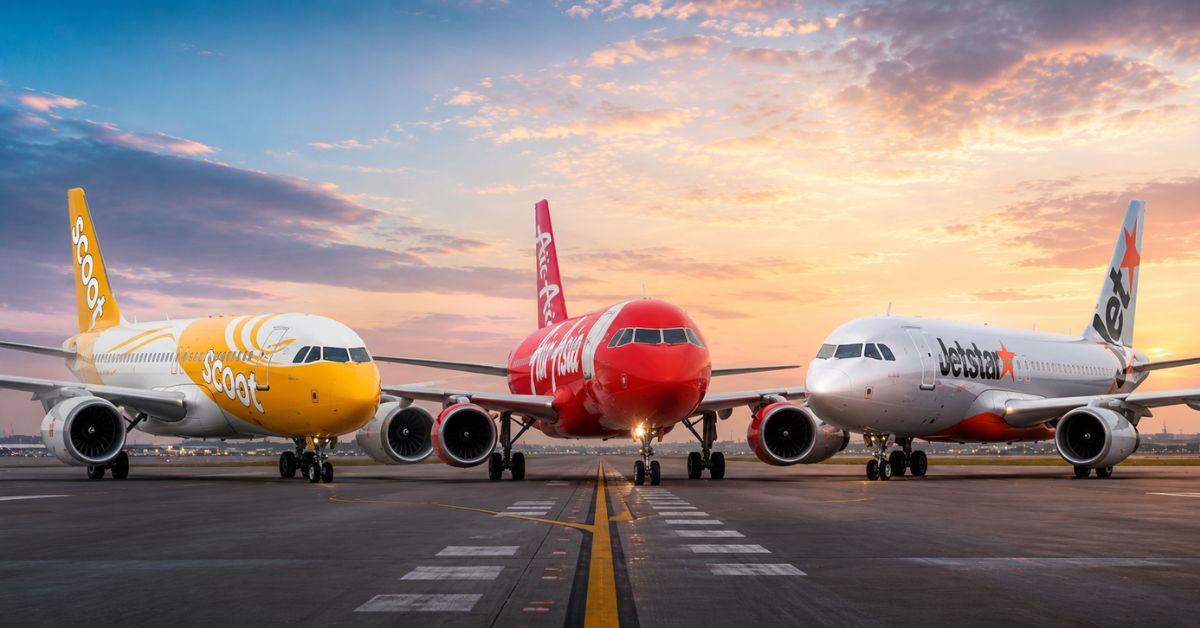
Whether you're flying out of Changi or connecting through it, these three carriers define budget travel across Asia-Pacific. This article provides you the insights on these airlines — safety rankings, on-time data, cabin specs, fees — so you don't have to.
Why This Comparison Still Matters
Budget airline loyalty in Asia isn't brand loyalty — it's route loyalty. Most travellers toggle between Scoot, AirAsia and Jetstar depending on price alerts and destination, which is quite smart. But knowing which airline is structurally better at what helps you make faster, smarter decisions — especially when the base fares look almost identical and the real cost hides in the add-ons.
This is a comparison built on publicly available 2025-26 data from various authentic sources. You will receive transparent, unfiltered information, completely free from exaggerated claims.
An Overview of the Three Featured Carriers
Scoot
Scoot is Singapore's own airline. Launched in 2012 as the low-cost arm of Singapore Airlines, it operates out of Changi Terminal 1 with a fleet of approximately 55 aircraft — Boeing 787 Dreamliners, Airbus 320neos, and Embraer E2s. For Singaporean travellers, it is the home carrier option in the budget space, with routes spanning Japan, Australia, India, the Middle East, and — remarkably for an LCC — into Europe. It reaches as far west as Athens and Berlin from Singapore, though it's worth noting that Berlin operations have been largely suspended and European long haul routes fluctuate; Athens currently remains Scoot's most stable European foothold. The Vienna route, heavily publicized on launch, has faced similar operational pressures. It's better to always verify active European routes directly on flyscoot.com before booking. The SIA parentage gives Scoot an institutional safety credibility that most standalone LCCs simply cannot replicate.
AirAsia
AirAsia is the region's network giant. Operating out of Kuala Lumpur's KLIA2, it runs the largest low-cost network in Asia by a wide margin. Group-wide, AirAsia operates 109+ aircraft to over 166 destinations across 25 countries, with long haul arm AirAsia X handling routes to Japan, Korea, Australia, and China. For Singapore-based travellers AirAsia usually requires positioning to KL first — which changes the true cost calculation significantly for short-haul travel — though Singapore-originating routes do exist. AirAsia's massive order book includes 383 aircraft for delivery through 2032. This primarily includes Airbus A321neo, A321XLR, and A330neo variants. AirAsia X is specifically preparing to deploy the A321XLR from late 2026 for "long, thin" routes into Central Asia and Eastern Europe — a move that will directly challenge Scoot's European ambitions.
Jetstar
Jetstar is the Australian entry. Backed by Qantas and headquartered in Melbourne, it operates 103 aircraft with a strong domestic Australia and Australia-NZ-Japan network. It posted revenue of A$5.71 billion in FY2024/25. The critical development for Asia-based readers: Jetstar Asia permanently ceased all operations on July 31, 2025, citing unsustainable supplier costs and intense local competition. All 13 of its Airbus A320s were absorbed back into Australia and New Zealand operations. The short-haul Southeast Asian network — Bangkok, Jakarta, Manila, Kuala Lumpur — that Jetstar Asia served from Changi is now permanently gone. and Scoot and AirAsia have absorbed most of that displaced demand.
Safety: Non-Negotiable, So Let's Get Specific
AirlineRatings.com's 2026 safety rankings assessed 320 airlines on incident rates, fleet age, fatalities, and compliance with IATA auditing standards. Jetstar Australia placed #2 globally among low-cost carriers. Scoot placed #3 — the highest-ranked ASEAN airline on the LCC list. AirAsia placed 10th.
For Singapore-based travellers, the Scoot ranking carries particular significance. Being ranked #3 globally while operating as a subsidiary of Singapore Airlines — itself ranked 7th among the world's safest full-service carriers in 2026 — means Scoot inherits a maintenance culture, safety auditing cadence, and technical oversight that independent LCCs typically cannot afford. Changi's airport infrastructure compounds this advantage: the MRO (maintenance, repair, overhaul) ecosystem around Singapore is among the most sophisticated in the world.
AirAsia’s 10th place ranking is pretty respectable genuinely — top tier globally. But there is one detail that really matters a lot for informed travellers: AirAsia isn’t just one airline, you know. The brand works through legally separate bodies across Malaysia, Indonesia, Thailand, the Philippines, and Cambodia — each one has its own Air Operator’s Certificate, gets regulated by its own national civil aviation authority, and has its own maintenance track record. AirlineRatings bundles them together as a “Group” just for the ranking purposes, yet in daily operations the reality feels different. AirAsia Malaysia, and AirAsia Indonesia, do not share the same safety history, and that part can’t be ignored. When booking, always note the operating carrier. This isn't fearmongering — it's the distinction seasoned regional travellers flag consistently in Singapore, KL, and Jakarta flying communities.
Network: The Singapore Traveller's Actual Options
From Changi Airport, your realistic LCC options break down like this:
Scoot gives you the most comprehensive budget network directly from Singapore. Japan (Tokyo, Osaka, Sapporo), Australia (Sydney, Melbourne, Perth, Gold Coast), India (Chennai, Amritsar, Jaipur, Hyderabad), China (10+ cities), Southeast Asia (Bangkok, Kuala Lumpur, Jakarta, Manila, Colombo), and European routes anchored by Athens. With 14–16 new aircraft planned for delivery, Scoot is actively expanding capacity — one of the few LCCs genuinely growing its long-haul footprint right now. Just double-check European routes before booking; Scoot's long-haul ambitions have historically bumped against commercial realities on specific city pairs.
AirAsia from Singapore is more limited than its total network suggests. Its true breadth radiates primarily from Kuala Lumpur. For a Singapore traveller, AirAsia is most compelling when the fare differential versus Scoot is large enough to justify positioning to KLIA2. On popular routes like Bangkok or Bali, the total cost including the KL connection can still undercut Scoot's direct fare — which is why Skyscanner comparisons with "include nearby airports" enabled are essential before you book.
Jetstar from Singapore is no longer a meaningful option. With Jetstar Asia permanently closed as of July 31, 2025, there is no Singapore-originating Jetstar operation. Australian travellers transiting Changi can still pick up Jetstar services from Australian cities onwards, but as a Singapore-based budget carrier, Jetstar has fully exited the market.
Punctuality: The Number That Actually Affects Your Trip
AirAsia X posted an 81.2% on-time rate in 2024 with a near-zero 0.1% cancellation rate. Scoot's internal OTP sits at approximately 79% for 2024, with Thai AirAsia recording approximately 77% via Cirium's 2024 punctuality tables. These figures align precisely with industry benchmarks — LCCs typically operate in the high-70% to low-80% bracket as a structural consequence of 30-minute aircraft turnaround windows. All three carriers are tightly clustered; raw OTP data alone shouldn't drive your airline choice.
What should drive it is what happens when things go wrong. Scoot's disruption management reflects SIA-group investment in passenger technology — app-based rebooking, automated flight notifications, and self-service check-in flows that actually work. AirAsia has built a similarly capable digital operation through its app, with a strong regional reputation for handling flight changes without requiring customers to call a helpline for an hour. Jetstar's disruption handling, particularly during the 2022–23 post-COVID cancellation wave, generated sustained negative press in Australia and Singapore — with customers reporting inflexible rebooking, inaccessible customer service, and significant out-of-pocket costs when plans changed.
One Skytrax-verified Australian passenger described the shift directly: "I was done with Jetstar a couple of years ago when they were cancelling flights left, right and centre causing lots of stress and expense. We now fly AirAsia to Bali." That move — from Jetstar to AirAsia on Perth–Bali, one of the highest-volume leisure routes in Australasia — reflects a measurable market preference shift that is visible in booking data on that corridor. (Source: Skytrax / AirlineQuality.com, Sep 2024)
Cabin Comfort: Where the Biggest Gap Lives
This is where Scoot genuinely separates itself for medium and long-haul routes.
Scoot offers four fare classes — Basic, Value, Flex, and ScootPlus — with options for extra legroom, quiet zones, and priority boarding at various price points. ScootPlus includes leather recliner seats, an inclusive meal, and a checked baggage allowance — typically priced SGD 100–180 above Basic, and competitive with full-service economy on 5–8 hour routes.
The structural advantage is the Boeing 787 Dreamliner on medium and long-haul routes. This isn't marketing — it's engineering. The 787's composite construction allows a cabin altitude equivalent of 6,000 feet versus the standard 8,000 feet on aluminium-fuselage aircraft like the A320. Higher cabin pressure means better humidity, less physical fatigue, and measurably reduced jet lag on arrival. On a Singapore–Tokyo or Singapore–Sydney run, this makes a tangible difference. Frequent flyers across Singapore's aviation community reflect it: "Between Jetstar and Scoot, I prefer Scoot as they use the 787 quite routinely and I prefer wide-body aircraft to narrow-body types." (Source: HardwareZone Forums, Singapore) One traveller on Roamscapes described being assigned an exit row Stretch seat and falling asleep almost immediately — not a phrase commonly written about LCC flying. (Source: Roamscapes.com, 2026)
AirAsia's entire short and medium-haul fleet is the Airbus A320 family — reliable, fuel-efficient, fine for flights under three hours. AirAsia X's A330 on long-haul routes improves the experience considerably, but at a fare premium that moves you out of pure budget territory. For classic ASEAN travel, the A320 is perfectly adequate. For anything over four hours, Scoot's Dreamliner becomes a meaningful differentiator.
Jetstar's short-haul A320 cabins drew consistent criticism in Skytrax reviews — tight pitch, minimal recline, cramped boarding. One verified passenger on Hong Kong–Singapore route described having to physically squeeze past seated passengers to reach a window seat. (Source: Skytrax / AirlineQuality.com) Jetstar Australia's 787 on trans-Pacific routes is a different product entirely, and a good one — but with Jetstar Asia gone from Singapore, regional travellers in Southeast Asia won't encounter it.
Fees and True Cost: What You're Really Paying
The base fare is theatre. The real cost is base + bag + seat + meal, and on all three airlines, those add-ons can double the sticker price if you're not careful.
Scoot provides the most generous cabin baggage allowance among the three carriers, with as much as 10kg in Economy and 15kg in ScootPlus, while AirAsia and Jetstar stick to a standard 7kg allowance. So for people trying to avoid checked baggage fees, that extra weight can turn into real savings, especially on those short to medium getaways. On the food side, Scoot also lets you pre-order and then buy meals onboard, and the pre-order approach usually feels like the better deal too, plus you get the widest selection there for longer trips.
AirAsia’s AirAsia Rewards program is one of the biggest airline loyalty ecosystems in Southeast Asia. It lets members collect and then use points across flights, travel services, and a set of selected partners. For people who often fly within ASEAN, it can keep giving real value, mainly because there are steady earning chances and promotions coming up. Jetstar’s tie-up with Qantas Frequent Flyer still feels like a real edge for travellers who are already in the Qantas world, especially if they go to/from, or even just around, Australia quite regularly.
When it comes to those ancillary fees, all three airlines seem to run on a low-cost carrier model, so things like checked baggage, choosing a seat, and a few other add-ons can quietly push the final ticket up a lot. In general, baggage bought at the airport is usually pricier than baggage that was pre-booked, across the industry. So, travellers probably should look at the whole trip cost, not only the “headline fare”, and if you know you will need baggage, a seat, or even meals then it makes sense to buy those during the initial booking, rather than later .
The universal rule is to get your checked bag, your seat, and your meal pre-buyed while booking across all three airlines. Look at the total bundled prices on Skyscanner, because the lowest “headline” fare is often not the actual cheapest deal.
Awards: What the Industry Says
At the 2025 Skytrax World Airline Awards, AirAsia basically took the title of World’s Best Low-Cost Airline overall, while Scoot sat in second place overall, and also received the separate honor as World’s Best Long-Haul Low-Cost Airline. What stands out is that AirAsia’s 2025 win was its 16th year in a row holding the World’s Best Low-Cost Airline crown, which is a record inside Skytrax history and highlights, in a meaningful way, how consistently the carrier keeps performing at scale across a very competitive region. Meanwhile, Jetstar came in second for the long-haul LCC category, right behind Scoot.
The split between these two award categories tells the competitive story precisely: AirAsia wins on breadth, value, and overall short-haul passenger experience. Scoot wins when the flight is long enough for aircraft type and cabin design to matter. They are targeting different travellers on different mission profiles — and knowing which one you are determines everything.
The Final Verdict
|
Your Profile |
Best Choice |
|
Flying from Singapore, 4+ hours, want comfort |
Scoot |
|
Frequent ASEAN hopper, KL as hub option |
AirAsia |
|
Australia-based, flying domestic or NZ/Japan |
Jetstar (Aus operation) |
|
First-time LCC traveller, safety + reliability first |
Scoot |
|
Building loyalty points across Asia |
AirAsia Rewards |
|
Qantas member, Australia-focused |
Jetstar + QFF |
|
Singapore–Europe on a budget |
Scoot — verify active routes first |
For Singapore-based travellers: Scoot is your default for anything over three hours. Its Changi-originating network is the most comprehensive of the three in the current market, its 787 fleet is a genuine differentiator, and the SIA safety umbrella matters. AirAsia is worth the KL positioning when the fare gap is large enough — model the true total cost before deciding. Jetstar, for the Southeast Asian market, is now a closed chapter.
Globally: AirAsia leads on network and value, Scoot leads on experience quality, and Jetstar leads in its home market of Australia. Know your route, build your true price, and stop making booking decisions on base fares alone.
Frequently Asked Questions(FAQ's)
Ans: The best airline depends on your travel priorities. If you're after long-haul comfort out of Singapore, Scoot is a strong choice; AirAsia boasts the largest low-cost network across Asia, making it great for regional travel; and Jetstar shines for travelers heading around Australia, New Zealand and selected international destinations. Consider factors such as routes, fares, baggage policies, and onboard services before booking.
Ans: All three airlines maintain strong safety records and operate under the safety regulations of their respective aviation authorities. In the 2026 AirlineRatings.com low-cost airline safety rankings, Jetstar Australia ranked second, Scoot ranked third, and AirAsia was placed among the top 10, making each a reputable choice for budget-conscious travellers.
Ans: Baggage allowances vary by fare type and route. In general, Scoot offers a more generous cabin baggage allowance on many fares than AirAsia and Jetstar, but it's always worth checking the baggage policy for your specific ticket before you travel.
Ans: The best loyalty program depends on how and where you travel. AirAsia Rewards is well suited for frequent travellers across Asia, Jetstar passengers can earn and redeem points through Qantas Frequent Flyer on eligible bookings, while Scoot participates in the Singapore Airlines Group's KrisFlyer program on eligible fares, allowing members to earn and redeem miles.
Ans: AirAsia has won the Skytrax World's Best Low-Cost Airline award multiple consecutive times, while Scoot has been recognized as the World's Best Long-Haul Low-Cost Airline for its long-distance travel experience.
Ans: For longer journeys, Scoot is often the preferred choice because many of its medium- and long-haul routes are operated by Boeing 787 Dreamliner aircraft, which offer features such as improved cabin humidity, lower cabin altitude, and a quieter environment compared with many older aircraft. Comfort can also vary depending on the aircraft type, seat selection, and fare purchased.